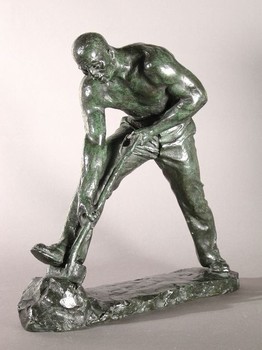
| 239. Max Kalish (Polish American, 1891-1945)
"The Digger" circa 1920-25.
Bronze with green and black patina. Signed M. Kalish ANA, with foundry mark Meroni Radice cire perdue Paris. 13 1/2" h., 15 1/4" l.
Provenance: by descent in the family of a Cleveland collector.
Born in Lithuania, Kalish immigrated to Cleveland, Ohio with his family when he was two years old. By the age of twelve, he was working in factories and shops as a laborer; his experience there gave him a deep appreciation and admiration for the American worker. During the course of his career, Kalish sculpted not only industrymen (steelworkers are among his most celebrated and heroic works), but also, farmers, road builders, railroad engineers, riveters, and blacksmiths.
In a newspaper article from "The Journal Magazine", c. 1926, Kalish was quoted as saying, "I watched men swing heavy hammers on white-hot bars of steel. I tried to analyze the motions of men digging ditches. I studied the muscles that rippled in their backs and arms and chests. And I learned that the American workman is a distinct type -- sturdier more beautifully formed physically than most races of men... I feel that the labor type found in this country is as fine and vigorous a type for sculptural art as is found anywhere in the world; the American worker is as great a figure in modern art as the Greek athlete was in his time."
Kalish graduated from the Cleveland School of Art and went on to study at the National Academy of Design under Alexander Stirling Calder, an academic sculptor himself and the father of the famous modern sculptor, Alexander "Sandy" Calder, as well as under Herbert Adams, C. S. Pietro, and the well-known
European bronze sculptor Isidore Konti. Kalish also studied in Paris at the Academie Colorossi, at the Academie des Beaux-Arts. Kalish's sculptures created a sensation at a 1914 Cleveland art show; artists and non-artists alike saw beauty and drama in the true-to-life figure of the laborer on the job.
Kalish explained that the success of his work was due to the fact that it addressed the concerns of its
period. "The only expressions of art that have lived through the centuries," noted Kalish, "are those that speak the language of their time. If America is to have a great art it must be an expression of our time and age, the industrial."
"The Greeks expressed their time in the famous sculptures of the figures of their mythical gods chiseled in the mold of the men and women who lived then," he continued. "During the Italian rennaisance the Church was the patron of art; in present-day America the captain of industry who has risen from the ranks of a struggling populace is the natural and outstanding patron of art."
Kalish's 1914 exhibition led to important portrait commissions from Warren G. Harding (then a senator) and
Newton D. Baker (then Secretary of War). Kalish's artistic career was then interrupted by World War I. He enlisted hoping to go to France (where he had studied at the Ecole des Beaux Arts), but the army chose instead to use his special talents as a plastic surgeon reconstructing the bodies and disfigured faces of many wounded American soldiers.
After his discharge in 1919, Kalish returned to sculpting and sought to glorify "the American laborer in deathless bronze." One of the characteristics which set Kalish's sculptures apart from equally skillful artists was his talent for portraiture. Rather than producing figures with relatively undifferentiated facial types, Kalish showed endless variety in the facial features of his figures. He sculpted many different races, ethnic
groups and ages. This single quality in his work may well be the result of his wartime experience as a plastic surgeon.
In addition to his sculptures of workingmen, Kalish is best known locally for his heroic bronze figure of Abraham Lincoln that stands in front of the Cleveland Board of Education building. School children funded the erection of this major work with small change. His powerful bronze entitled "Angry Christ" and the family sculpture he named "The Greatest Love", executed in marble, are among his most famous works.
10,000/15,000 SOLD: $25,300.00
Condition: very minor handling wear to patina.

|